
By Dave R, High School Biology Teacher and Department Head
I’m writing this on a Sunday evening in late August, sitting in my classroom as I prepare for the first week of the new school year. My lesson plans are spread across my desk, but they look nothing like they did a year ago.
Tomorrow, weather permering, I’m taking my AP Biology students outside for our first “walking lecture” through the nature preserve behind our school. Six months ago, I would have called this impractical. Today, I call it essential.
This transformation didn’t happen in a workshop or from a book. It happened on the trails of Bali, where I learned that hiking could be something far more profound than exercise it could be a path back to purpose.

What You’ll Discover in My Story:
- Why standard wellness retreats failed me and what made Bali different
- How the concept of Tri Hita Karana transformed my understanding of teaching as sacred practice
- The specific hikes and experiences that created lasting change in my life and work
- Practical integration strategies I’m using six months later in my daily teaching
- Why a local guide made all the difference for someone who usually travels independently
- Honest reflections on what worked, what was challenging, and what’s sustainable long-term
- Who this experience is really for (and who might want to look elsewhere)
The Crisis: A Teacher Who Forgot Why He Taught
Last February, I turned 49. I’d been teaching high school biology for eighteen years at the same suburban school district, the last five as department head. On paper, I had achieved everything I’d set out to do when I graduated with my teaching degree at 27. I had tenure, respect from colleagues, decent test scores, and a pension waiting for me in sixteen years.
I also had a creeping sense of dread that this was all there was.
I don’t mean that dramatically. I wasn’t having a breakdown. It was more like a slow fade the kind you don’t notice until you realize you’ve been teaching the Krebs cycle the exact same way for a decade and a half, and the words coming out of your mouth sound like a recording. I was going through the motions. My students were fine.
I was fine. Everything was fine in that suffocating way that fine can be when you remember that once, a long time ago, you had passion for this work.
I used to love teaching. I became a biology teacher because I wanted kids to see the sacred in the scientific to understand that studying a cell is studying a miracle, that evolution is a story more epic than any myth. Somewhere along the way, I’d reduced it all to test prep and curriculum standards.
The Discovery: Finding Bali Palms
My wife saw something in me that I was trying to hide. Over winter break, she sat me down and said, “You need to do something that scares you a little.” She’d been researching wellness experiences and found Bali Palms in Tabanan not a typical hotel or resort, but a sanctuary that offered pre-packaged getaways designed for different personal needs.
I was immediately skeptical. I teach science. I appreciate evidence-based approaches. “Authentic connection to place” sounded like exactly the kind of language that makes me uncomfortable. But the testimonials weren’t from yoga influencers; they were from professionals like me people in their forties and fifties who seemed thoughtful and grounded.
She showed me their different packages: Mind, Body and Soul Retreats of varying lengths for those ready for a yoga-focused experience, Romance packages for couples, and more relaxed options like the Escape package.
What caught my attention wasn’t just the hiking emphasis it was the fact that they offered tailored packages for greater flexibility. I wasn’t ready to commit to a structured retreat; I needed something that would meet me where I was.
What ultimately convinced me was the emphasis on guided experiences with local partners and something called Tri Hita Karana a Balinese philosophy about balance between humans, nature, and the divine. As someone who teaches ecology, the interconnectedness piece resonated.
I booked their Escape package for a week in April, during our spring break.
Arriving Skeptical, Staying Open
When I arrived at Bali Palms in Tabanan, I was skeptical and worried I was “too intellectual” for the transformation others described. I chose the flexible Escape package, not the structured yoga retreats, and appreciated its luxury accommodation, meals, transport, and guided hikes.
My guide, Wayan from the local village, wasn’t just a tour guide but a teacher who introduced me to Tri Hita Karana the Balinese principle of harmony between humans, nature, and the spiritual world.
He said, “We don’t hike to conquer the mountain. We walk to restore balance,” which profoundly shifted my perspective.
The Transformation: Hiking Bali’s Sacred Landscapes
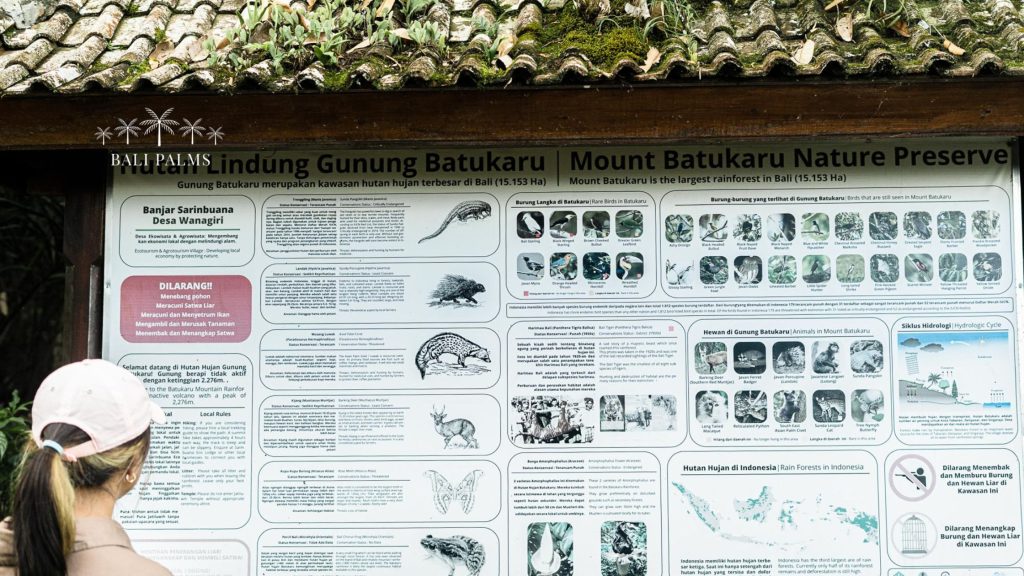
Mount Batukaru: Where Walking Became Ceremony
Our first real trek was through the rice paddies and dense jungle trails around Mount Batukaru, the second-highest volcano in Bali and one of the island’s most sacred mountains. This wasn’t the touristy sunrise trek up Mount Batur that every adventure tour operator offers. This was quiet, contemplative, and almost entirely empty of tourists.
The trail itself was challenging steep and mossy in places, requiring real focus. But Wayan walked at a pace that felt almost ceremonial, much slower than I would have gone on my own. When I mentioned this, he smiled and said, “Walking can be a ceremony. The Balinese people have always known this.”
He explained that their religious processions are walking meditations, ways of connecting the body to the land and the spirit to the divine. I’m not a religious person, but something about that reframing made sense to me.
We stopped frequently not because we were tired, but because Wayan would point out details I would have walked right past:
- A massive Banyan tree considered sacred, where locals had left offerings
- A specific turn in the path created centuries ago to honor the mountain gods who provide the village’s water
- Small shrines tucked into the lush jungle, which he walked around, never over
According to a study in the Journal of Indonesian Tourism and Development Studies (2020), nature-based tourism activities like hiking are shown to significantly reduce stress and improve mental well-being by fostering connection with the natural environment.
By the third day, I noticed my shoulders had dropped about two inches. The chronic tension I carry in my jaw had released.
Sidemen Valley: The Moment Everything Changed
On day four, we walked through the rice terraces of Sidemen Valley in East Bali, with Mount Agung as a dramatic backdrop. This less crowded region offers the “real Bali” beyond mass tourism.
We met a farmer who explained the ancient subak irrigation system, embodying Tri Hita Karana. Listening to him, I realized I’d forgotten that what I taught was sacred, not just science. Wayan nodded, saying, “The trail is a teacher. You’re listening now.”
The Sacred Geography: Understanding Bali’s Spiritual Landscape
What I came to understand through these hikes is that for the Balinese people, the island isn’t just beautiful it’s a living temple. Every mountain, forest, and waterfall has spiritual significance:
Mount Agung is considered the home of the gods, the highest and most sacred peak. While we didn’t climb to its summit (that requires a more challenging overnight trek and special preparation), its presence dominated the eastern horizon of nearly every hike.
Rice fields and rice paddies aren’t just agriculture they’re sacred spaces of sustenance and community, tended with spiritual practices that date back centuries.
Waterfalls are sites for melukat, or spiritual cleansing rituals, where the force of the water is believed to wash away spiritual impurities.
Dense jungle areas contain medicinal plants that have been used for generations in traditional Balinese healing.
The forests around Mount Batukaru, according to a study in the Journal of Biological Diversity (2023), contain incredible biodiversity. Walking here wasn’t just exercise it was immersion in a pristine ecosystem that has been protected by spiritual reverence.
The Practice: What Made This Different
Why a Local Guide Changed Everything
I need to address something for anyone reading this who, like me, usually prefers independent exploration: I would have completely missed the depth of this experience if I’d tried to do it alone.
I’m the kind of person who usually prefers solo travel. I like moving at my own pace, making my own discoveries. And yes, I could have found lists of the best hikes in Bali online. I could have rented a scooter, picked a trail, and explored.
But I would have walked on the surface of a profound culture without ever touching its depth.
Wayan wasn’t just showing me trails he was translating an entire worldview. He had relationships with the farmers in the rice fields, permission from village elders to take me to certain sacred sites, oral histories that aren’t written in any guidebook.
When we encountered a temple complex along one path, he explained its significance—not just the architecture, but the ceremonies held there, the role it plays in village life, the offerings placed by locals every morning. Without him, I would have seen a pretty building and taken a photo. With him, I understood it as a living part of the spiritual geography.
For analytical thinkers like me who tend to resist guided experiences because we want to “figure it out ourselves,” I’d say this: some knowledge can’t be figured out. It can only be received through relationship.
Respectful Hiking: What I Learned About Etiquette
One of the most valuable things Wayan taught me was how to hike respectfully in a place where nature is considered sacred:
Modest dress: I always carried a sarong in my pack. When our path took us near temple sites, I wrapped it around my waist. This simple act of respect often opened doors literally. At one temple, the priest invited us in to observe a ceremony because he could see we understood proper protocol.
Greetings: Wayan taught me to say “Om Swastiastu” when meeting people on the trail. This traditional Balinese greeting acknowledges the divine in the other person. The warmth with which people responded was noticeably different than when tourists simply said “hello.”
Offerings: When we encountered small offerings on the path flowers, incense, rice Wayan always walked around them, never stepping over. He explained these were prayers made physical, deserving the same respect as a person in prayer.
Quiet near sacred sites: In areas near temples or shrines, Wayan spoke in hushed tones, and I followed his lead. This wasn’t oppressive it created a contemplative atmosphere that actually enhanced the experience.
This cultural sensitivity wasn’t separate from the hiking experience it was integral to it. Paying attention to where I stepped, how I dressed, and how I interacted forced me to be present. It was, in itself, a mindfulness practice.
The Physical and Spiritual Benefits
The physical benefits were immediate and tangible. Most hikes were moderate in difficulty we’d typically walk for three to four hours, covering varying distances depending on the terrain. The elevation gains were challenging but manageable. I’m in decent shape from cycling, but I definitely felt the workout, especially on the steeper ascents.
But the real transformation was neurological and psychological. According to research on nature-based activities, immersion in natural environments significantly reduces cortisol levels and improves mental clarity. I can confirm this wasn’t just a feeling it was physiological.
By day three, I was sleeping better than I had in years. My chronic jaw tension released. The constant mental chatter that usually runs in my head quieted. For someone who lives primarily in his analytical mind, this nervous system reset was profound.
More importantly, the combination of physical movement through sacred landscapes created a unique state. I wasn’t just thinking about presence or reading about mindfulness I was experiencing it viscerally, in my body, with every step.
The Integration: Six Months Later
How I’ve Applied This to My Teaching
It’s been six months since I returned from Bali, and I want to be honest: it hasn’t been a straight line of transformation. I still have days where I fall back into autopilot. But the difference is that now I notice when I’m doing it, and I have practices to return to.
Walking as Daily Practice
I started walking to school instead of driving a twenty-five-minute walk through our neighborhood and a small nature preserve. Every morning, I practice what Wayan taught me: syncing my breath with my steps, noticing details I’d previously ignored, treating the walk as a moving meditation rather than just transportation.
Some mornings, I’ll stop by a particular oak tree that reminds me of the sacred Banyan we visited in Bali. I don’t leave offerings that would be appropriation but I pause there and practice gratitude. It sounds small, but it’s transformed my entire morning. I arrive at school grounded instead of frantic.
Outdoor Biology Curriculum
The bigger change happened in my teaching. I’ve integrated what I’m calling “walking lectures” into my biology curriculum. Once a week, weather permitting, we go outside. We walk through the nature preserve behind our school, and I teach ecology not from a textbook but from the living system we’re moving through.
Last year, I would have told you this was impracticalwe’d lose class time, students would be distracted, it wouldn’t translate to test scores. This year, I see it as essential. My students need to feel their connection to the natural world, not just understand it intellectually.
I’m also bringing the concept of Tri Hita Karana into my teaching, carefully explaining its Balinese origins. We talk about balance between human needs and environmental health, between individual success and community wellbeing, between scientific knowledge and wonder at what we’re studying.
Student Impact
A few weeks ago, a student approached me after class and said, “Mr. Richardson, you seem different this year. You seem… happier?” I told her about Bali, about learning that teaching could be sacred practice when approached with presence.
She paused and then said, “I think I actually like biology now.”
That’s when I knew something had fundamentally changed.
Daily Practices I’ve Maintained
- Morning walks: 5 days a week, treating the commute as ceremony
- Desk altar: A simple arrangement of natural objects a stone, a leaf, water to set daily intention
- Mindful transitions: Taking three conscious breaths between classes instead of rushing
- Weekly outdoor teaching: Integrated into curriculum, not an “extra”
- Evening reflection: Five minutes of journaling about moments of presence during the day
These aren’t elaborate practices. They’re small, sustainable habits that keep me connected to what I learned on those trails in Bali.
Practical Guide: What You Need to Know
Best Regions for Transformative Hiking in Bali
Based on my experience, here are the regions that offered the deepest connection:
Tabanan Region and Mount Batukaru
The sacred green heart of Bali, where I spent most of my time. Less touristy than Ubud, with pristine jungle trails and rice paddies that feel timeless. The forests here, according to research, contain exceptional biodiversity.
This is where Bali Palms is located in Tabanan, making it an ideal base for nature lovers seeking authentic experiences. The proximity meant we could start hikes early in the morning when the jungle was alive with birdsong and return to comfortable accommodation for reflection and rest.
Sidemen Valley (East Bali)
Stunning rice terraces with Mount Agung as backdrop. More serene than the famous terraces near Ubud. Trails often lead through traditional villages where you can meet artisans and farmers. Perfect for combining nature with cultural immersion.
Munduk and North Bali
Cooler climate, hidden waterfalls, clove plantations. These trails offer great views down to the sea and pass through communities where Balinese life continues much as it has for generations. The Campuhan Ridge Walk near Ubud is popular, but North Bali offers similar beauty with far fewer crowds.
West Bali National Park
While I didn’t visit this area on my trip, it came highly recommended for serious hikers and nature lovers. More remote and wild, it requires more planning but offers incredible biodiversity and chances to see rare wildlife.
Physical Preparation
Most of the hikes I did were moderate difficulty. You don’t need to be an elite athlete, but a baseline fitness level helps. If you can comfortably walk for three to four hours with some elevation gain, you’ll be fine.
More important than physical fitness is mental preparation. Let go of rigid schedules. Be willing to walk slowly. Accept that a trek “supposed” to take one hour might take three because you engage in conversation with a farmer or are invited to observe a ceremony.
Frequently Asked Questions
How much does this kind of experience cost?
I spent about $2,500 for the week, covering flights from the East Coast, my Escape package at Bali Palms (including luxury accommodation, meals, transport, and guided hikes), and extras. This mid-range cost reflects the quality of guidance and cultural connection rather than luxury. Bali Palms offers various packages, from structured retreats to relaxed and tailored options for flexible experiences.
How physically demanding are the hikes?
Most were moderate difficulty. Three to four-hour walks with some elevation gain and occasionally steep or slippery sections. I’m 49 and in decent but not exceptional shape, and I managed fine. The pace was contemplative, not aggressive. The most challenging aspect was the humidity, not the terrain.
How do I find an ethical operator?
Ask questions like: Who are your guides? Are they from local villages? How do you ensure tourism benefits locals? A good operator will be transparent about their community partnerships.
Bali Palms works exclusively with local guides from Tabanan, focusing on authentic cultural connections, small groups, and sustainable practices. Choose operators who clearly value community relationships and offer flexible packages to suit your needs.
Dave R. is a real guest who experienced this transformative journey with us. We’ve changed his name and some identifying details to protect his privacy, but this story authentically represents his experience at our retreat.