
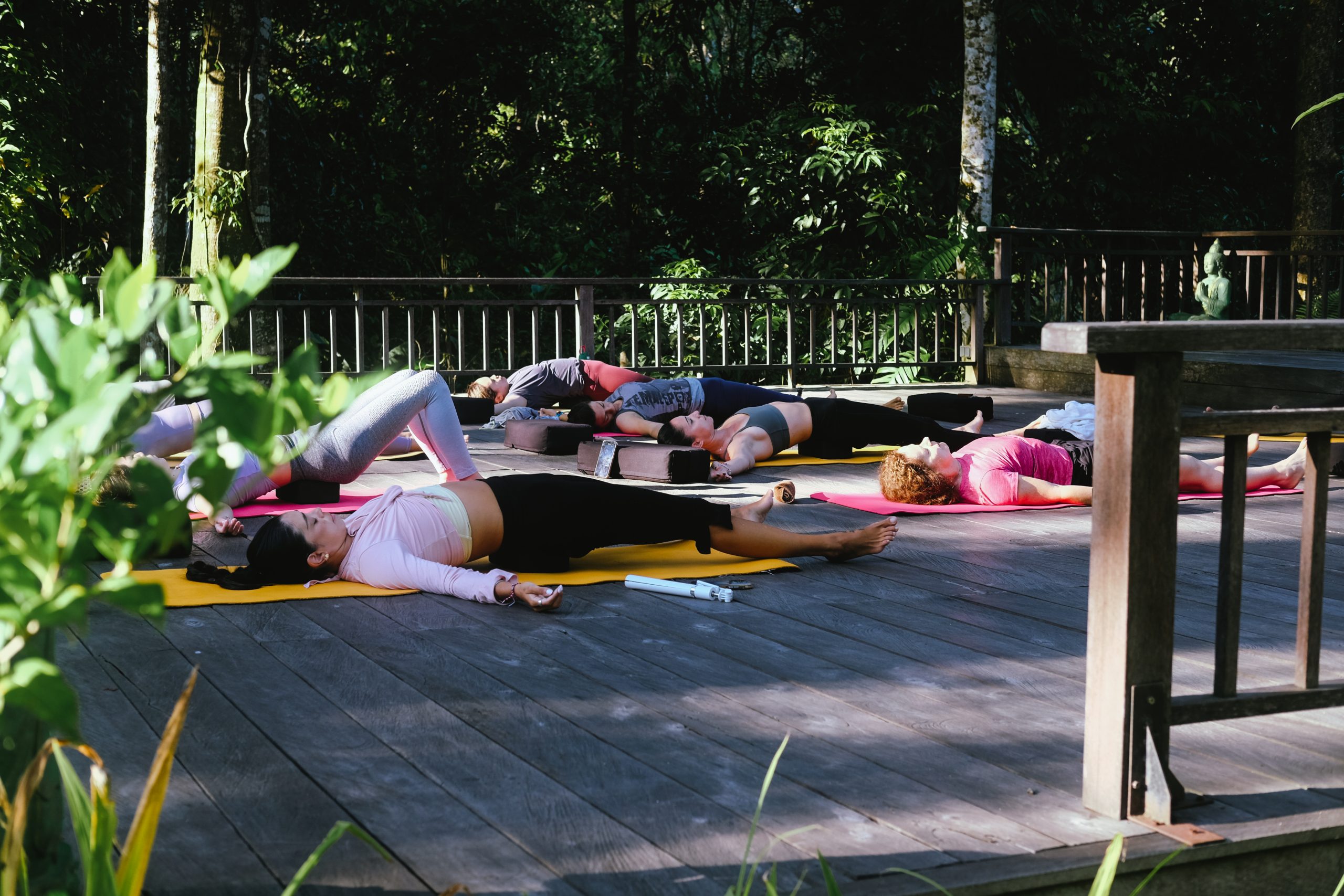
People book a yoga retreat in Bali for many different reasons. Some have a committed practice and want to deepen it. Some have barely set foot on a mat and are drawn by the idea of learning in a beautiful place. Some are not particularly interested in yoga at all — they are interested in what yoga retreats tend to produce: a few days of structured rest in an environment that supports it.
All three of these are valid starting points, and all three tend to produce something similar by the end of a retreat at Bali Palms: a different relationship with their own body, a different quality of attention, and an understanding of yoga that did not arrive through a class or a video or an app.
This is what a yoga retreat in Bali actually teaches — and why the teaching is almost never about the poses.
Why Location Matters More Than You Might Expect
Yoga can be practised anywhere. The question of where you practise it is not about the quality of the instruction or the difficulty of the sequence — it is about what else the environment is doing while the practice is happening.
At Bali Palms, the yoga deck opens onto tropical jungle. Morning sessions begin at sunrise, before the heat of the day builds. The sounds are birds and insects. The temperature at this elevation in Tabanan is cooler than the south of Bali. The air carries the particular quality of altitude and living green things.
This is not incidental to the practice. The body’s capacity for presence — its ability to actually inhabit what is happening in a session rather than processing the day ahead — is directly influenced by what is around it. Practising yoga in a room with air conditioning and mirrors is a different physiological experience from practising yoga in an open-air structure at the edge of a jungle. Neither is better or worse in absolute terms. But for a retreat context — for the specific purpose of arriving somewhere new in yourself — the latter tends to go deeper.
Twice Daily: Why the Frequency Matters
The yoga retreats at Bali Palms — Mind, Body and Soul — all include twice-daily sessions: a longer, more movement-focused practice in the morning, and a slower, more restorative or meditative practice in the evening.
This rhythm is not arbitrary. It reflects how the body actually processes a yoga practice differently at different times of day, and how the cumulative effect of twice-daily sessions builds across a retreat in a way that a single daily class cannot.
By day three of a seven-night retreat, most guests are doing things in their practice that surprised them on day one. Not because the instruction has become more advanced, but because something in the body has opened — accumulated loosening in the fascia, a different quality of breath, a nervous system that has had three days of twice-daily regulation and has begun to respond differently.
This is the most concrete way to describe what a yoga retreat produces that a yoga class does not: continuity. The practice builds on itself across the days of the retreat in a way that is simply not available in a weekly class.
What ‘All Levels’ Actually Means
The yoga retreats at Bali Palms welcome guests at all levels — including, specifically, those with no prior yoga experience.
This phrase appears frequently in retreat marketing and is sometimes used loosely. At Bali Palms, it means that the morning sessions are taught with the assumption that some participants have never practised before. Postures are introduced with alignment guidance, modifications are offered without comment or judgement, and the pace of instruction gives newer practitioners time to find what they need.
For guests with an existing practice, the sessions are structured to offer sufficient depth that they are not marking time. The Balinese instructors who teach at Bali Palms teach from a tradition that holds yoga as a practical tool for the mind — not a performance discipline — and this orientation tends to produce sessions that are equally relevant to the experienced practitioner and the complete beginner.
The most common response we hear from guests who arrived describing themselves as beginners: “I didn’t know yoga could do that.”
The Three Yoga Retreat Programmes at Bali Palms
Mind Retreat — For Those Seeking Peace
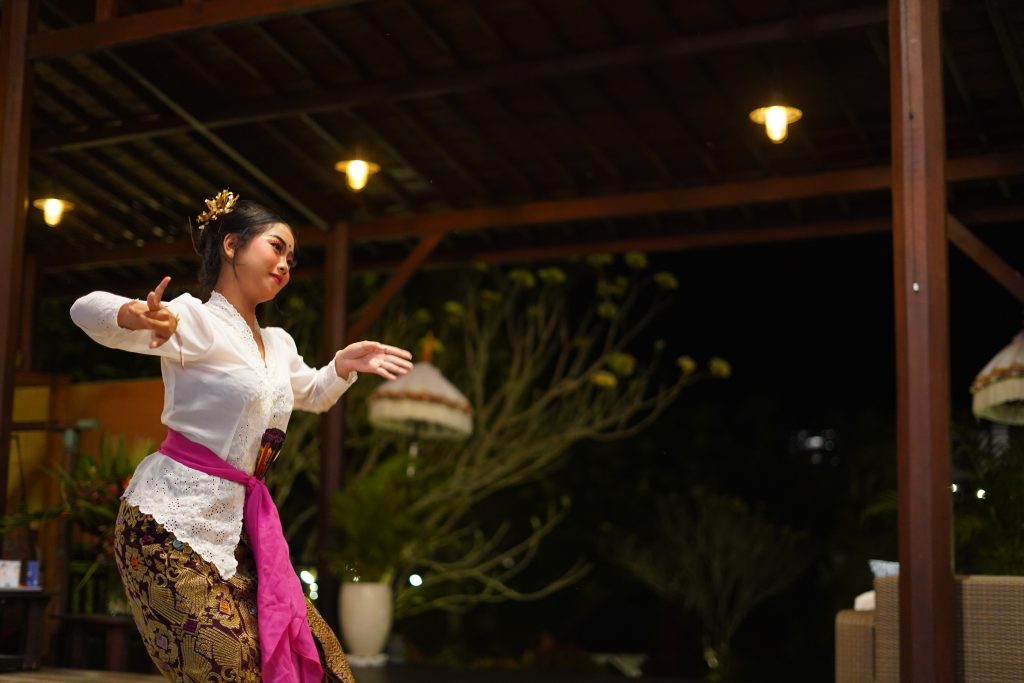
The Mind Retreat is built for guests who want to slow down and arrive somewhere quieter. Alongside twice-daily yoga and meditation, it includes a Balinese massage and cultural workshops — hands-on introductions to traditional Balinese practices such as offering-making, cooking and local dances. The cultural element is not decorative. Understanding something of the Balinese relationship with stillness, ritual and daily spiritual practice tends to deepen the quality of the yoga practice itself. For guests whose minds are running fast and who need something to genuinely settle them, this is the programme.
Body Retreat — For Those Seeking Adventure
The Body Retreat is for guests who want to move — not just on the mat, but through the landscape. Alongside twice-daily yoga and a Balinese massage, it includes guided jungle trekking through the forests and river valleys surrounding the resort. The physical challenge of the trekking and the physical discipline of the yoga complement each other: the body that has walked through jungle for two hours arrives at the evening yoga session in a very different state from the body that has spent the day by the pool. For guests who feel better when they are physically active, this programme gives the retreat its energy.
Soul Retreat — For Those Seeking Healing
The Soul Retreat is the most inward of the three programmes, and the most rooted in Balinese spiritual tradition. Alongside twice-daily yoga and a Balinese massage, it includes a session with a traditional Balinese healer — a practitioner working within an unbroken lineage of ceremonial and spiritual healing. Optional of Melukat (a sacred water purification ceremony), sound healing and five-elements healing for guests who want to go deeper. For those at a moment of transition, processing grief, or looking for something that goes beyond the physical practice, this is the programme designed to hold that.
All three programmes are available in 4, 5, 6 and 7-night formats.
After the Retreat
The most consistent thing guests say when they leave a yoga retreat at Bali Palms is that they want to continue the practice when they return home. Not in a vague, aspirational way — but specifically. They have identified postures that helped something. A breathing technique that settled something. A time of day that works for them.
This is perhaps the most practical thing a yoga retreat in Bali offers: not a transformation, but a toolbox. Something specific and transferable that belongs to you after the retreat is over and the jungle is behind you.
That tends to be exactly what people came for, even if they could not have named it before they arrived.